Monday, January 17, 2011

The Importance of Chanting the Invocation of Patajali


First I guess is who was Patanjali? 

Although not a lot is known about the life of Patanjali, it is believed that he lived somewhere between 500 and 200 BC.  He has been acknowledged for giving the Yoga tradition its classical format and so it is often referred to as Classical Yoga.  He is most widely known for writing the Yoga Sutras, which is a systematic treatise defining the most important aspects of Yoga theory and practice.  He has also been acknowledged for being a grammarian and doctor of Ayurvedic medicine.  On top of this he is known as the patron saint of dance in India.

The legend surrounding Patanjali is that he may be the grandson of Brahma.  He was sent to earth to write a commentary on grammar and devote himself to the perfection of dance. He came to earth as a tiny snake and grew into human form before his mother’s eyes.  She named him Patanjali.  Pata meaning fallen and anjali meaning “hands folded in prayer”. He is depicted as being half human and half serpent.  Patanjali is thought to have 4 hands.  Two are in the namaste position, one holding a sankha or conch that embodies energy and one a cakra, a disc that embodies the turning wheel of time or the law of cause and effect.

Mr. Iyengar says in Light on the Yoga Sutras of Patanjali that Patanjali’s works are followed by yogis to this day in their effort to develop a refined language, a cultured body and a civilized mind.  This is referring to all the great works of Pantanjali on grammar, dance and yoga.


INVOCATION TO PATANJALI
yogena cittasya padena vacam
malam sarirasya ca vaidyakena
yopakarottam pravaram muninam
patanjalim pranjalir anato'smi


abahu purusakaram
sankha cakrasi dharinam
sahasra sirasam svetam
pranamami patanjalim

 
English Translation:

Let us bow before the noblest of sages, Patanjali, who gave yoga for serenity and sanctity of mind, grammar for clarity and purity of speech, and medicine for perfection of health.
Let us prostrate before Patanjali, an incarnation of Adisesa, whose upper body has a human form, whose arms hold a conch and a disc, and who is crowned by a thousand-headed cobra.

The first part of the invocation salutes Patanjali’s achievements as the founding figure of yoga and his achievements in grammar and ayurvedic medicine.  The second part salutes Patanjali for carrying the conch and wheel.  The part where he is crowned by a thousand-headed cobra refers to his form as Anata or Adisesa, the devine serpent and that in biting his own tail symbolizes endlessness.

The importance of chanting the invocation to Patanjali prior to beginning your yoga practice is that it reminds us of the original culture and tradition yoga came from and gives respect and gratitude to Patanjali for giving yoga to us.  In calling respect to Patanjali at the beginning of the yoga practice also humbles the yoga student so the true lessons of yoga can be learnt.

You can listen to B.K.S. Iyengar chant the invocation by visiting http://www.bksiyengar.com/

Namaste.
Pamela Nelson

Friday, January 14, 2011

Yogasana or Bhogasana?

The word yogasana means a yogic posture.  Yogasanas were discovered by sages to keep us healthy and satisfied by exercising every muscle, nerve and gland in the body.  Asana (postures) bring great vitality, health and lightness; helping to produce mental equilibrium and steadiness of mind.  When we do not use the asanas as a bridge to unite the body with the mind and the mind with the soul then we are merely doing bhogasanas, or asanas of pleasure.

B.K.S. Iyengar says in Light on Pranayama, 
"The external world lures us towards its pleasures, creating desires. The inevitable non-fulfilment of desires in turn creates pain, which suffocates the inner being." 
These afflictions or sufferings (klesas) are said to have five causes: ignorance, pride, attachment, aversion and fear of death. 
Therefore, we need determination to practice the asanas correctly to free ourselves from the afflictions of physical disabilities and mental distractions.

Namaste.
Pamela Nelson
www.plnyoga.blogspot.com
email: plnyogastudio@gmail.com

Resources used: Light on Pranayama and Light on Yoga, by B.K.S. Iyengar and Yoga Rahasya vol.17 No.3, 2010.
Any mistakes in presenting this are my own.

Tuesday, January 11, 2011

Yamas and Niyamas - Intentions of the next 10 weeks - Week 1: Ahimsa

Way back at the end of October I wrote about Patanjali and how he has been credited for codifying yoga in the Yoga Sutras.  I had listed the 8 limbs of yoga (astanga yoga) being yama, niyama, asana, pranayama, pratyahara,dharana, dhyana and samadhi.

Over the next 10 weeks I hope to write about the yamas - which there are 5 and the niyamas -which there is also 5.  Each one will be the intention of the week during the Winter Yoga Session.

So to begin, Yama is the first limb in our eight limb path.  The yamas are the ethical disciplines or the great commandments transcending creed, country, age and time.  They represent the rules of morality for society and the individual, which as B.K.S. Iyengar writes if not obeyed bring chaos, violence, untruth, stealing, dissipation and covetousness.
Sutra II.31 states this as:  jati desa kala samaya anavacchinnah sarvabhaumah mahavratam
Translated as: Yamas are the great, mighty, universal vows, unconditioned by place, time and class.

Ahimsa is the first yama. It means non-harming  or wishing no harm in words, thoughts and actions.  It is being sincere.
Sutra II.35 states this as: ahimsapratisthayam tatsannidhau vairatyagah
Translated as: When non-violence in speech, thought and action is established, one's aggressive nature is relinquished and others abandon hostility in one's presence.

The sutras stress that yama and niyama are an essential part of yoga, not just the postures we have come to know in western society.  The postures though can help us learn much about ourselves so we can develop equipoise in all areas of our lives.  Mr. Iyengar says, "In asana, the pose first brings inner balance and harmony, but in the end it is merely the outer expression of the inner harmony.

Namaste.
Pamela Nelson
http://www.plnyoga.vpweb.com/
email: plnyoga@plnyoga.vpweb.com

Thursday, January 6, 2011

Citta

Citta - the sanskrit word for consciousness, which is made up of three factors.  The mind (manas), intellect (buddhi) and the ego (ahamkara).  The mind has three functions - cognition, conation or volition, and motion.

From "Light on the Yoga Sutras of Patanjali", BKS says, "Mind acquires knowledge objectively, whereas intelligence learns through subjective experience, which becomes wisdom."

I like this quote because it always reminds me to do my practice.  I can continue to read...and reread many of the books I have and think I understand it, but not until I gain the realization through experience can I say I have wisdom.

Namaste.

Pamela Nelson
www.plnyoga.BlogSpot.com
email: plnyogastudio@gmail.com

Yoga for the Office - Practice 1

I have recently taken on some computer work and although I know the effects of desk jobs can cause chronic neck, shoulder and back issues I was surprised at how quickly one can start to feel these symptoms.

Below is a practice that is good for anyone, but especially for those that sit for long periods at desks, in vehicles...or even on the couch!  If you stop for even five minutes every hour to do a few of these postures, it might help counter the negative effects of desk jobs. 

Namaskarasana - Begin in a seated position with your feet hip distance apart and parallel.  Press firmly into your feet, and sit evenly on your sit bones. Press your palms together at chest height, keeping your wrists and elbow in line.  Release your shoulder back and down away from your ears, while at the same time keep your spine lengthening and chest open.

Maintaining the same position of your feet, length to your spine and openness to the chest, interlace your fingers.

Keep your shoulders moving back and down and press your hands away from you, palms facing out.  Try to keep your arms straight and parallel to the floor.

Bring your chin to your chest, inhale and raise your straight arms overhead.  Continue to press out through your palms.  As your arms stretch up, keep the shoulders moving back and down and keep the chest open, feet pressing to floor.

On your next inhale, levelize the head.  On an exhalation release the arms down and repeat the last five poses interlacing your fingers with your opposite pinkie finger to the outside.

Stand with feet hip width apart and feet parallel.  Bring your weight evenly into your feet.  Front to back, side to side.  Engage your quadriceps (thigh muscles) and compact your outer hips.  Lift your waist off of your hips, lengthening the side body evenly to the armpits.  Raise your arms out to the side, parallel to the floor, and keep your shoulders moving down the back.  Press out through the palms and feel a greater release in the neck and shoulder area.  Draw the arms behind you as far as you can.  Bring arms back in line with body and palms facing the floor. 
Maintain the action in your legs and arms.  Inhale and on exhale release ear over to shoulder.  Don't let the shoulder move up to the ear.  Inhale to levelize the head and repeat on other side. 

Ardha Uttanasana - Place palms on desk, shoulder width apart.  Step back keeping feet hip width apart and parallel to each other bending at the hip crease - not the waist.  Feel the spine lengthening and lower back releasing.  Try to keep the tailbone in line with the heels.  Allow the abdomen to soften and outer thighs roll inward.  Lift the kneecaps up towards the hips to engage the quadriceps muscles and keep the femur bones (thigh bones) pressing back.  On inhalation walk feet towards hands and press to come up.  

Sit again in your chair.  Keep feet parallel and hip width apart.  Sit bones pressing evenly into chair.  Inhale, lengthening your spine, rolling your shoulders back and down and keep your chest open.  Exhale, bring your right hand to the outside of the left knee, revolving to the left. Take a few breaths to complete the twist beginning from the tailbone up to the base of the neck.  Look beyond the left shoulder, stretching the eyes as far as they can too!  On the exhalation come back to centre and repeat on other side.

This pose is great to quiet the mind and release the back and shoulders.
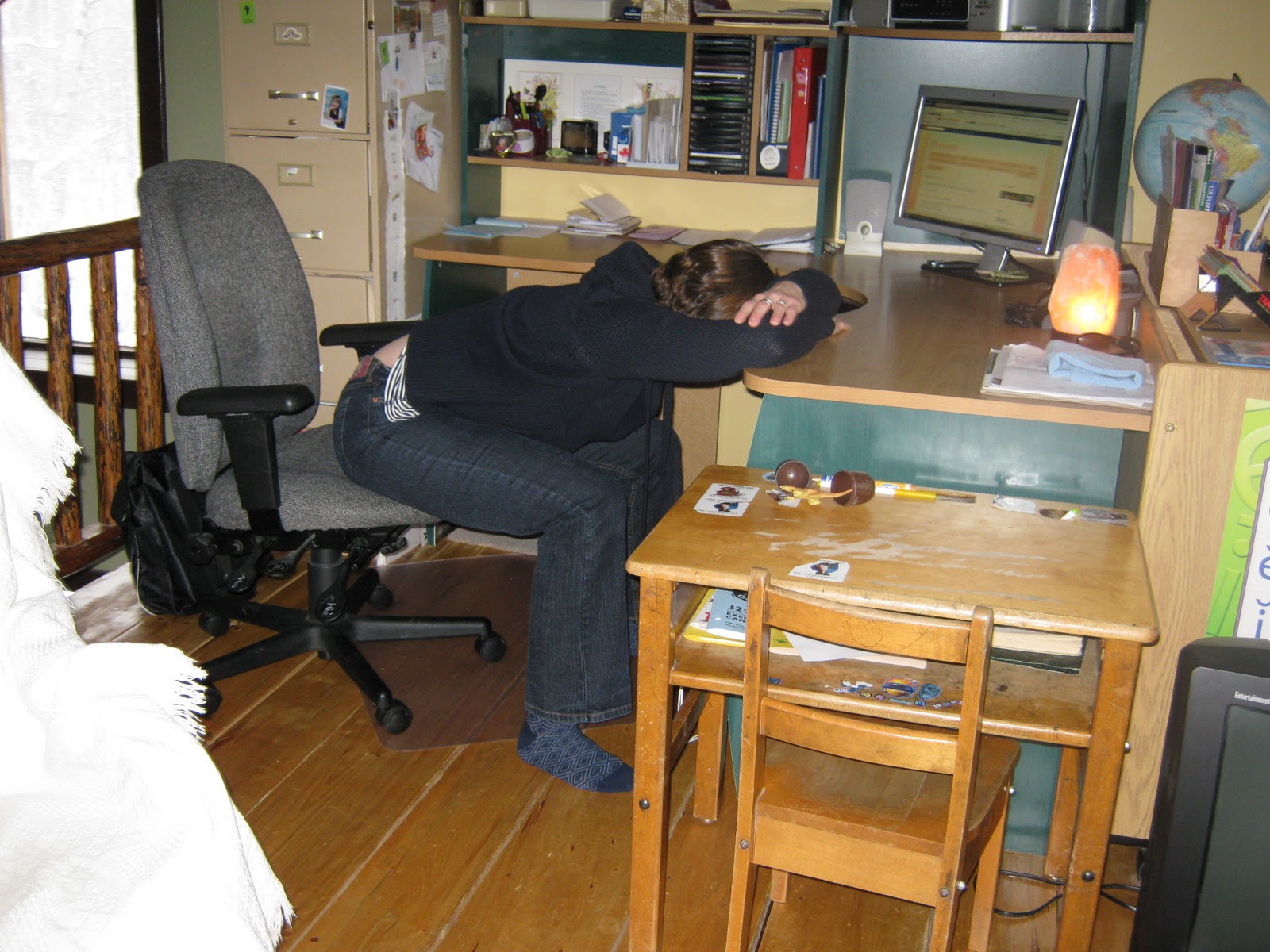
Feet are hip width apart and parallel. Release forward, bending at the hip crease, grasp opposite elbows and release forward.  Rest your forehead on your folded arms or on the desk.  Feel the muscles of the back releasing, the shoulders relaxing and the abdomen softening to release tension.  Stay for as long as you can.  Slowly come up on the inhalation.  Sit for a moment or two feeling calm, relaxed and ready to proceed with your day.

Namaste.

Pamela Nelson


Monday, January 3, 2011

Upcoming Winter Iyengar Yoga Classes

Happy New Year!

Below is my 2011 Winter Yoga Classes.

Mondays - in Christopher Lake - 10 weeks - January 10th - March 21- no class Feb.21
5:15-6:30 - Beginner Yoga
6:45-8:00 - Intermediate Yoga

Tuesdays - in Prince Albert - 10 weeks - January 11th - March 22 - no class Feb.22
5:30-6:45 - Intermediate Yoga - Full
7:00-8:00 - Beginner/All Levels - Full

Wednesday Workshops
January 19, February 9th, March 2 and 23rd
5:30-7:30

Saturdays - in Prince Albert - 6 weeks - January 8-Feb.19th - no class January 29th
10:30-11:45 - Beginner/All Levels - FULL


I will be posting the spring session in the next week or so.  It will run about 8 weeks starting in April.

Namaste.
Pam Nelson
http://www.plnyoga.vpweb.com/