Monday, November 21, 2016

Upcoming Classes


My Winter Schedule will be out soon but if you are looking for a few extra classes please join me at Yoga Sublime studio in Prince Albert.


November 25th - 5:30-6:30Peace Practice - Class by donation.
This month proceeds to Amnesty International Canada.  Stay after for a potluck and sutra study.
We will be discussing the Yama's and Niyama's. Please pre- register.

December 8th - 7:15-8:30 p.m. - Free Yoga Class - Beginner Iyengar Yoga - a great way to try out new classes or add in an extra stretch during the holiday season.  Please pre-register.

December 15th - 7:15-8:30 p.m. - Building a Home Practice - learn tips to build a successful home practice. A few handouts will be given too to help get you started. $17 drop in or Yoga Sublime 1.25 hour class passes can be used.
Yoga Sublime is located at 1998 Central Ave., Prince Albert, Sk.
 
 
December 21st - 6:00-8:00 p.m. - Celebrate Winter Solstice - The longest night of the year bring contemplation and chance to journey inwards and celebrate the coming of longer days ahead. 
Join me at my home studio in Christopher lake for a soothing and nourishing yoga practice for the body, breath and soul. Stay after for a visit with tea and appetizers. $25/person


Pre- register by emailing me at plnyogastudio@gmail.com or Yoga Sublime Studio at yogasublimestudio@gmail.com


Namaste.
Pamela Nelson
www.plnyoga.BlogSpot.com

Friday, November 18, 2016

Light on Yoga - Day 50

Image result for happy 50th anniversary


Tribute to Guruji and Light on Yoga - Day 50

Wow!  So now as I look back on the last 50 days it was actually a bit of a challenge to fit in writing this blog everyday. It has made me "practice" my yoga a little differently some days too which is what yoga is about.  The practice on the mat to prepare you for life off the mat.

Even though I have owned this book for years I am amazed at what I learned or re-learned reading it again and I'm sure I will continue to for many years to come.

In an article written by Prashant Iyengar titled "Guruji's mind on Light on Yoga", he writes that Guruji never took pride in Light on Yoga.  He says the whole world took pride on it and called it the Bible of Yoga.  But, Guruji never even quoted from Light on Yoga or took pride in it.

Prashant also writes that, "Light on Yoga was not written for his students. It was written for outsiders who did not have teachers.  That is why he said that a good book is better then a bad teacher."

For this I am grateful as I have not been fortunate enough to study with Mr. Iyengar over many years like the senior teachers have.  I have gained insights from many wonderful teachers over the years and will continue to as this is invaluable, but living in Northern Saskatchewan away from my senior teachers this book has been a wonderful resource and reference.

Learning more about Mr. Iyengar's journey to write Light on Yoga also inspires me to be a better student of yoga, not just master the final pose in the picture.


So, once again I give great gratitude to Mr. Iyengar and how he shared his knowledge of yoga over his lifetime with the world. Also, to his family as they have contributed greatly and continue to keep the teachings alive. 

Happy 50th Anniversary!

Namaste.
Pamela Nelson
www.plnyoga.BlogSpot.com


Thursday, November 17, 2016

Light on Yoga - Day 49

Image result for bks iyengar bhastrika

Tribute to Guruji and Light on Yoga - Day 49

I am at the last section of Light on Yoga.  Here descriptions are given for many other types of pranayama. 

They include:
Bhastrika Pranayama - means bellows, so the air is forcibly drawn in and out.

Kapalabhati Pranayama - means skull shining

Mr. Iyengar writes that both above pranayamas help to activate and invigorate the liver, spleen, pancreas and abdominal organs.  It can improve digestion and leave one with a sense of exhilaration.

Bhamari Pranayama - means bees breath.  There is a soft humming during exhalation like the sound of bees.

Sitali Pranayama - where sitali means cool, this pranayama helps to cool the system.  This is done by protrude the tongue our during the inhalation.

Other pranayama's given:
Sitakari, Sama Vrtti and Visama and Viloma, Anuloma and Pratiloma.

It is worth taking the time to read about the many pranayama's even if you are not attempting them at this time and understand that some may be better for a certain circumstance and that not all may be good for everyone depending on where they are on their yogic journey.

Namaste.
Pamela Nelson
www.plnyoga.BlogSpot.com

Wednesday, November 16, 2016

Light on Yoga - Day 48

Image result for bks iyengar ujjayi pranayam

Tribute to Guruji and Light on Yoga - Day 48

The last sections of Light on Yoga before the appendix continues with the technique and effects of pranayama and then pranayama.

Ujjayi pranayama is explained first in this section.  Mr. Iyengar writes ud is a prefix and means upward or expanding and conveys the sense of power.  Jaya means conquest, victory, success and Mr. Iyengar writes that also when looked at in another way implies restraint or curbing.  Ujjayi pranayama is the process where the lungs are fully expanded and the chest puffed out like a proud warrior.

A detailed outline of the basic technique is given and the effect of this pranayama is said to aerate the lungs, remove phlegm, give endurance and soothe the nerves.


Image result for bks iyengar ujjayi pranayam
 

Surya Bhedana Pranayama is explained in the technique and effect section too.

Surya means the sun and Bhedana is explained as meaning to pierce, break or pass through.
Going back to the information on the nadi's - in this pranayama the breath is inhaled through the right nostril, where the prana passes through the pingala or surya nadi.  The breath is exhaled through the left nostril, the path of the Ida nadi.

This slow, steady breath also soothes and invigorates the nerves and cleans the sinuses.
Image result for bks iyengar ujjayi pranayam

Last in this section is Nadi Sodhana Pranayama.
Nadi as you recall means a tubular organ.  Mr. Iyengar says that this nadi has three layers like an insulated electrical wire.  The innermost layer is the sira, the middle is the damani. 
Sodhana means to purify or cleanse.  In this pranayama the nerves are purified. 
The inhalation begins through the right nostril while the left nostril is closed,  at the top of the inhalation the right nostril is gently closed, the left opened to exhale through the left nostril.  Then inhale through the left and exhale from the right.

The nerves are refreshed, calmed and purified.


It is recommended at the end of a pranayama session to lie in Savasana.

Image result for bks iyengar ujjayi pranayam

This section gives many more tips, hints and cautions and is important to read and digest.

Namaste.
Pamela Nelson
www.plnyoga.BlogSpot.com


Tuesday, November 15, 2016

Light on Yoga - Day 47


Tribute to Guruji and Light on Yoga - Day 47

I love this line Mr. Iyengar writes about the body.  He says, "The human body is a miniature universe in itself."

It is so true and it is amazing how little we often know or learn about our own bodies as we take our awareness anywhere but inwards.

The word Hatha is composed of the ha meaning sun and tha meaning moon.
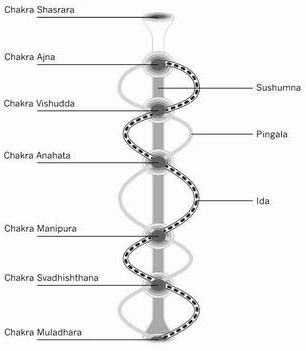
This is the solar and lunar energy that is said to flow through the  two main nadis or tubes.  They are the Pingala and Ida nadi.  They start at the nostril and move down to the base of the spine.

Pingala is said to be the nadi of the sun and Ida of the moon.  Between them is Susumna or the nadi of fire.  The main channel for the flow of nervous energy and is situated along the spinal column.  The Pingala and Ida intersect each other and the Susumna at various places along the spine.  These junctions are said to be the chakras or wheels mentioned in an earlier post.

Image result for nadi yoga

Mr. Iyengar writes that the chakras may correspond the endocrine glands, that supply hormones and other internal secretions to the system.

It is interesting to learn about the human body and correlate it to the energy body.  The bandhas then help to move this energy up the spine through the chakras to awaken the practitioner.

Namaste.
Pamela Nelson
www.plnyoga.blogspot.com


Monday, November 14, 2016

Light on Yoga - Day 46

Image result for bandhas


Tribute to Guruji and Light on Yoga - Day 46


Uddiyana bandha was mentioned earlier in the section of Light on Yoga called "Bandha and Kriya".  Mr. Iyengar did write he would talk more about the bandhas later.  He again stresses that there is a danger in learning the bandhas incorrectly, and even when learnt correctly that there are dangers as energy is retained.  This can often lead to bhoga or the enjoyment of worldly pleasures and not Yoga the union with the Supreme Soul.

To refresh, Uddiyana means flying up.
In this bandha the diaphragm is lifted up towards the thorax and the abdominal organs are moved back towards the spine.  This bandha is to be performed during the interval between complete exhalation and fresh inhalation when breathing is suspended.  The diaphragm and abdominal organs are exercised and the heart is also gently massaged.

Mula means root so this bandha is located in the lower pelvic region and should be attempted first after the inhalation.  Here the lower abdomen between the navel and the anus is contracted towards the spine and pulled up towards the diaphragm.  By contacting this region Mr. Iyengar writes, "Apana vayu (the prana of the lower abdomen), whose course is downwards, is made to flow up to unite with the Prana vayu, which has its seat in the region of the chest."

Mula bandha is often first learnt while doing asanas like Tadasana, sirsasana, sarvangasana, ustrasana and paschimottanasana.  So, again the limbs of yoga are linked and one is preparing the body in asana for pranayama and beyond.

It is well worth reading this section of Light on Yoga many times to understand the importance of these bandhas.

Namaste.
Pamela Nelson
www.plnyoga.BlogSpot.com