Tuesday, November 15, 2016

Light on Yoga - Day 47


Tribute to Guruji and Light on Yoga - Day 47

I love this line Mr. Iyengar writes about the body.  He says, "The human body is a miniature universe in itself."

It is so true and it is amazing how little we often know or learn about our own bodies as we take our awareness anywhere but inwards.

The word Hatha is composed of the ha meaning sun and tha meaning moon.
This is the solar and lunar energy that is said to flow through the  two main nadis or tubes.  They are the Pingala and Ida nadi.  They start at the nostril and move down to the base of the spine.

Pingala is said to be the nadi of the sun and Ida of the moon.  Between them is Susumna or the nadi of fire.  The main channel for the flow of nervous energy and is situated along the spinal column.  The Pingala and Ida intersect each other and the Susumna at various places along the spine.  These junctions are said to be the chakras or wheels mentioned in an earlier post.
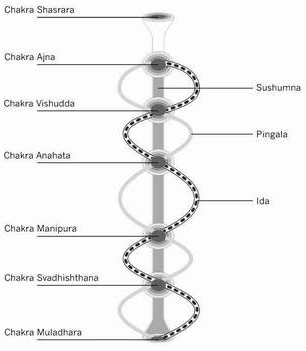
Image result for nadi yoga

Mr. Iyengar writes that the chakras may correspond the endocrine glands, that supply hormones and other internal secretions to the system.

It is interesting to learn about the human body and correlate it to the energy body.  The bandhas then help to move this energy up the spine through the chakras to awaken the practitioner.

Namaste.
Pamela Nelson
www.plnyoga.blogspot.com


Monday, November 14, 2016

Light on Yoga - Day 46

Image result for bandhas


Tribute to Guruji and Light on Yoga - Day 46


Uddiyana bandha was mentioned earlier in the section of Light on Yoga called "Bandha and Kriya".  Mr. Iyengar did write he would talk more about the bandhas later.  He again stresses that there is a danger in learning the bandhas incorrectly, and even when learnt correctly that there are dangers as energy is retained.  This can often lead to bhoga or the enjoyment of worldly pleasures and not Yoga the union with the Supreme Soul.

To refresh, Uddiyana means flying up.
In this bandha the diaphragm is lifted up towards the thorax and the abdominal organs are moved back towards the spine.  This bandha is to be performed during the interval between complete exhalation and fresh inhalation when breathing is suspended.  The diaphragm and abdominal organs are exercised and the heart is also gently massaged.

Mula means root so this bandha is located in the lower pelvic region and should be attempted first after the inhalation.  Here the lower abdomen between the navel and the anus is contracted towards the spine and pulled up towards the diaphragm.  By contacting this region Mr. Iyengar writes, "Apana vayu (the prana of the lower abdomen), whose course is downwards, is made to flow up to unite with the Prana vayu, which has its seat in the region of the chest."

Mula bandha is often first learnt while doing asanas like Tadasana, sirsasana, sarvangasana, ustrasana and paschimottanasana.  So, again the limbs of yoga are linked and one is preparing the body in asana for pranayama and beyond.

It is well worth reading this section of Light on Yoga many times to understand the importance of these bandhas.

Namaste.
Pamela Nelson
www.plnyoga.BlogSpot.com


Saturday, November 12, 2016

Light on Yoga - Day 45


Image result for chakras


Tribute to Guruji and Light on Yoga - Day 45

Bandhas, Nadis and Chakras
 
After the Hints and Cautions for Pranayama were given Mr. Iyengar writes more about the bandhas and includes information also about nadis and chakras.
 
 
Bandhas are described as a bondage or joining together and a posture in which certain organs or parts of the body are contracted and controlled.
 
 
Nadi is a tubular channel in the body through which energy flows and chakra means wheel or circle and in the body act like fly-wheels to help channel the energy.
Image result for nadi yoga
 
The main three bandhas that are important for pranayama are: Jalandhara bandha, uddiyana bandha and mula bandha.
 
Image result for bandhas
Mr. Iyengar recommends that a yogi master Jalandhara bandha first.  Jala is a net or web, like a mesh. In this bandha the neck and throat are contracted and the chin rests on the notch between the collar-bones and top of breast bone. In this position the flow of blood and prana to the heart, glands neck, head and brain is regulated.  Pranayama done without the chin lock will leave one feeling pressure in the heart, behind the eyes, in the ears or even dizzy.  It is essential to learn for the inhalation, exhalation and retention of the breath.
 
 
Today if you practice Sarvangasana or halasana, notice how the chin lock is employed in this pose. So even before you may feel you are formally learning pranayama you are learning elements of it from the asana. 
 
 
Day 46 will explore what Mr. Iyengar writes about Uddiyana bandha and Mula bandha in Light on Yoga.
 
Namaste.
Pamela Nelson

Light on Yoga - Day 44


Image result for bks pranayama


Tribute to Guruji and Light on Yoga - Day 44

Pranayama - Hints and Cautions

In Part Three of Light on Yoga Mr. Iyengar gives information and instructions on Pranayama.

He begins first with the Hints and Cautions and right from the beginning asks the reader to read and digest the information thoroughly before attempting.

Here are some of the Hints and Cautions:

- pranayama training demands mastery of asanas and the strength and discipline arising from them.
-observe the rules of cleanliness
-the best time to practice is in the early morning, before sunrise or after sunset.
- practice should be done in a clean airy place, free from insects.

On Posture: - here are only a few
- breathing through the nose, except when stated
- seated on floor on blanket in a steady position.  Postures like Siddhasana, virasana, padmasana and baddhakonasana.
- no strain on facial muscles should be felt
- jalandhara bandha should be performed except where stated
-eye kept closed
-do not force or strain the breath
- evenness in breathing leads to a healthy nervous system and an even mind and temper
-do not practice asana right after pranayama
-after pranayama practice lie down for 5-10 minutes in savasana so the mind and body is quiet and passive.
-Do not attempt kumbhakas or retentions until master a smooth inhalation and exhalation

Mr. Iyengar writes, " In the practice of pranayama the senses are drawn inwards and in the silence of the kumbhaka the aspirant hears his inner voice calling: "Look within! The source of all happiness in within!'. This also prepares him for the next stage of yoga, pratyahara, which leads to freedom from the domination and tyranny of the senses."

Namaste.
Pamela Nelson
www.plnyoga.BlogSpot.com

Friday, November 11, 2016

Light on Yoga - Day 43


Tribute to Guruji and Light on Yoga - Day 43

Mr. Iyengar gives a short few pages on the bandha's and Kriya's after the asana section.

In the glossary of Light on Yoga, bandha is defined as: bondage or fetter.  It means a posture where certain organs or parts of the body are contracted and controlled.

Kriya is defined as: An expiatory rite, a cleaning process.

In the short few pages Mr. Iyengar gives an explanation only of Uddiyana Banda and Nauli kriya.

Uddiyana means flying up.  It is a way to regulate the flow of energy or prana.  Here the prana moves from the lower abdomen towards the head.  Mr. Iyengar gives step by step instructions in a standing position and states that it is a preliminary step for the practice of pranayama.

It is said to help tone the abdominal organs and eliminate toxins in the digestive tract.

Nauli  is where the abdominal muscles and organs are made to move laterally and vertically in a surging like motion. 
Nau means a boat and li means to cling to, to lie on, hide or cover.
Mr. Iyengar exercises caution in performing this kriya and not recommended for the average practitioner.
He recommends mastering uddiyana bandha first.

Namaste.
Pamela Nelson
www.plnyoga.BlogSpot.com


Thursday, November 10, 2016

Light on Yoga - Day 42


Tribute to Guruji and Light on Yoga - Day 42

Also in the appendix of Light on Yoga, Mr. Iyengar gives sequences to help improve some ailments.

Here is a few that are listed - headache, hunchback, sciatica, insomnia and backache. Really only name a few.

Yoga is holistic in that it doesn't just work one part of the body, mind or breath  - but encompasses the whole of the person from inside out and back to the core again.

Since I was teaching a Backs and Joints class today I decided I would try the Backache sequence.
I know this would have been a bit intense for that class it does have many great postures to improve movement in the spine and bring freedom in the back.


As I am coming to the last week of the 50 day tribute the next few days will be information on pranayama from Light on Yoga.

Thank you for reading so far.

Namaste.
Pamela Nelson
www.plnyoga.BlogSpot.com


Namaste.
Pamela Nelson
www.plnyoga.BlogSpot.com