Friday, February 24, 2012

Words of Wisdom - 15

We lose our time because
we lose our attention.

-Jacob Needleman


Namaste.
Pamela Nelson


Thursday, February 16, 2012

The Bandhas - basic information

Bandha means bound.  In yoga, it is an action where certain organs or parts of the body are contracted and controlled to reverse the pranic flow of energy.  They can be performed in asana, pranayama and mudras, although it is recommended that the bandhas be practiced with the supervision of a experienced teacher.  If performed incorrectly strain may be put on some of the body's organs.  The increase in pranic energy must also be contained and used correctly. In Light on Yoga, Mr. Iyengar says that, "with the mastery of the three bandhas, the yogi is at the cross-roads of his destiny. One road leads to bhoga or the enjoyment of worldly pleasures; the other leads to Yoga or union with the Supreme Soul."


Jalandhara Bandha (neck lock) - Neck and throat are contracted by locking the chin in the notch between the collar-bones and the top of the sternum bone. When performed correctly the cervical and thoracic vertebrae are aligned so that prana can flow freely to the cranial area.  The practice of Sarvangasana (shoulder stand) has the jalandhara bandha.

Uddiyana Bandha - Uddiyana means flying up.  The abdominal organs are drawn towards the spine with the diaphragm lifted up.  B.K.S. Iyengar writes in Light on Yoga, "It is said that through Uddiyana Bandha, the great bird prana is force to fly up through the susumna nadi, the main channel for the flow of nervous energy, which is situated inside the meru-danda or the spinal column."  The diaphragm and abdominal organs are exercised and the heart is gently massaged.
According to Mr. Iyengar, Uddiyana bandha should only be performed during the interval between complete exhalation and inhalation when breathing is suspended.  It should never be attempted during the interval between  complete inhalation and the start of exhalation when the breath is retained.  It can strain the heart and diaphragm and the eyes will puff out.

Mula Bandha - Mula means root or base.  In this bandha the lower abdomen between the navel and the anus is contracted and pulled towards the diaphragm so that region is locked upwards.  When performed the apana is prevented from being released.

Information for this blog from:
Yoga: A Gem for Women, by Geeta Iyengar
Light on Yoga, by B.K.S. Iyengar
The Chakra Bible, by Patricia Mercier


Namaste.
Pamela Nelson
www.plnyoga.vpweb.com

Sunday, February 12, 2012

Quote from the Buddha

Thousands of candles can be lighted from a single candle,
and the life of the candle will not be shortened.
Happiness never decreases by being shared.

-The Buddha

Wednesday, February 8, 2012

At any moment, you have a choice,
that either leads you closer to your spirit or
futher away from it.

-Thich Nhat Hanh


Namaste.
Pamela Nelson


Tuesday, February 7, 2012

February Pose of the Month - Purvottanasana

Purvottanasana - Intense Stretch to East Side of Body

Purva means East.  In this pose it means the whole front of the body - as Mr.Iyengar writes from forehead to the toes.  Uttana means intense stretch, so the anterior side of the body is lengthened and stretched, as well as strengthening the arms, wrists, shoulders and spine.


 Begin in Dandasana, sitting evenly on sit bones, and extend legs out.  Keep the legs straight and firm and the chest lifting and open.

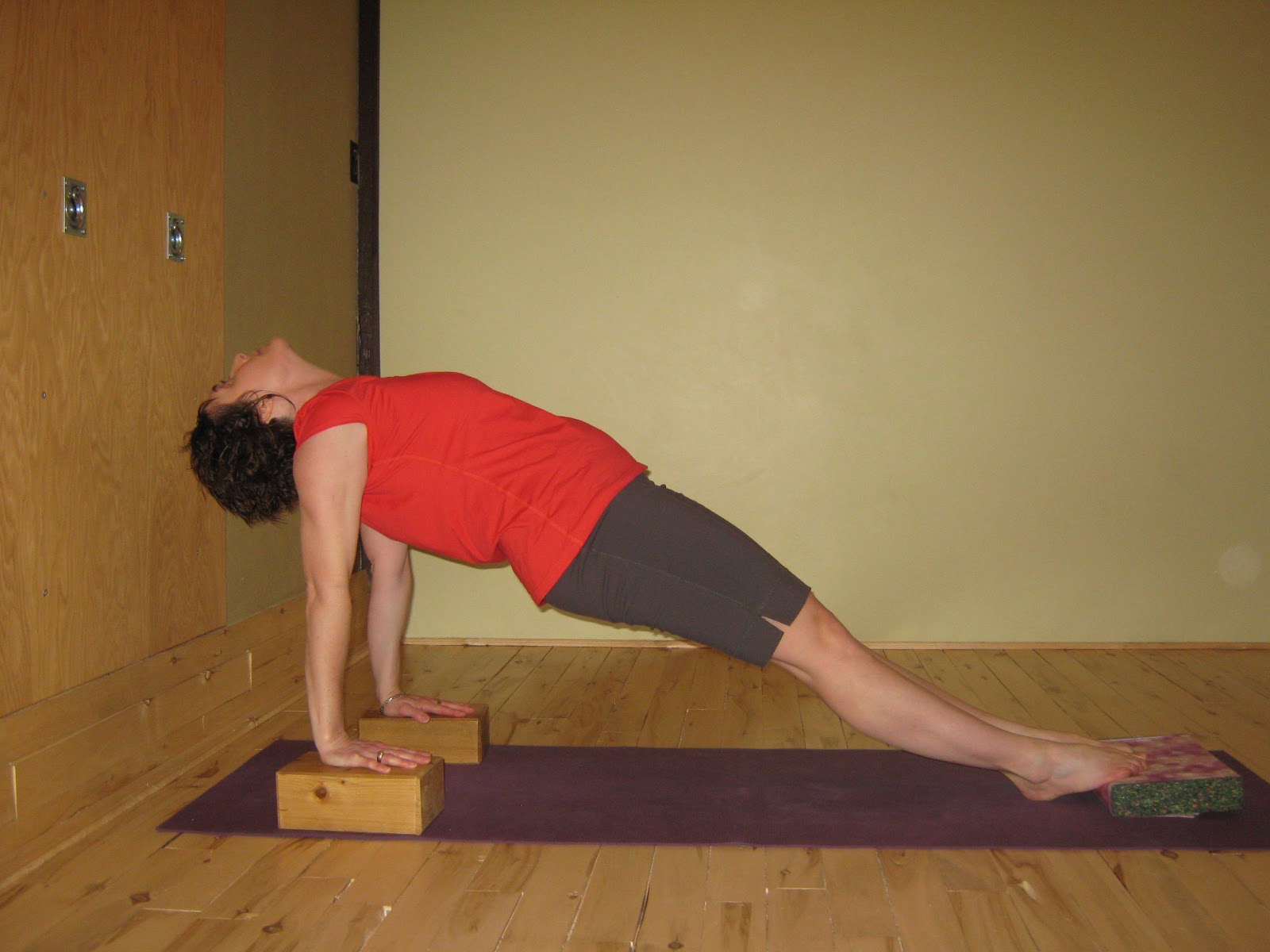
In this variation the hands are brought onto blocks behind the hips with fingers pointing forward.
Inhale and lift and open chest further, keep shoulders away from ears and legs firm.
On same inhalation press into hands, draw tailbone up and lift hips off the floor and press feet into the floor keeping legs straight.  If feet don't press to floor use a foam block to press the toes into.
Bring the head back opening the throat. 
Stay for a few breaths, breathing normally.  Continue to press the tailbone and hips up.  Engage the quadriceps muscles and firmly draw the kneecaps up.  Feel the whole back body lifting up.
Exhale, and release back down to Dandasana.


If you can do the pose without the blocks.
All ages can even enjoy the benefits of yoga!


Salamba Purvottanasana - Supported Stretch to the East Side of the Body

In this pose I have placed a mat near a wall.  Two chairs are then arranged with one near the wall and another on the mat to prevent them from slipping.
Another mat has been put onto the chairs so the bolsters don't slip.
Two bolsters have then been stacked with a slight stagger between them.
I have used a folded blanket to support the back of the head and neck.

Sit on the edge of the bolster and then gently recline back.  Keep the legs straight, outer thighs rolling in and feet pressing into the floor.  A strap can even be used around the upper thighs to keep the legs from rolling out.  As the outer shoulders release down and away from the ears, keep the abdomen relaxed and soft, as well as the face and throat.


Here I have just raised the arms overhead and grasped the elbows to help lengthen and elongate the torso further.


Benefits:
Strengthens the wrists, ankles, arms, spine and shoulders, as well as stretching and expanding the chest fully.
This pose benefits the internal and reproductive organs, as well as the diaphragm and heart.


Cautions:
Watch if have wrist or shoulder issues. 


Namaste.
Pamela Nelson